veranomotors
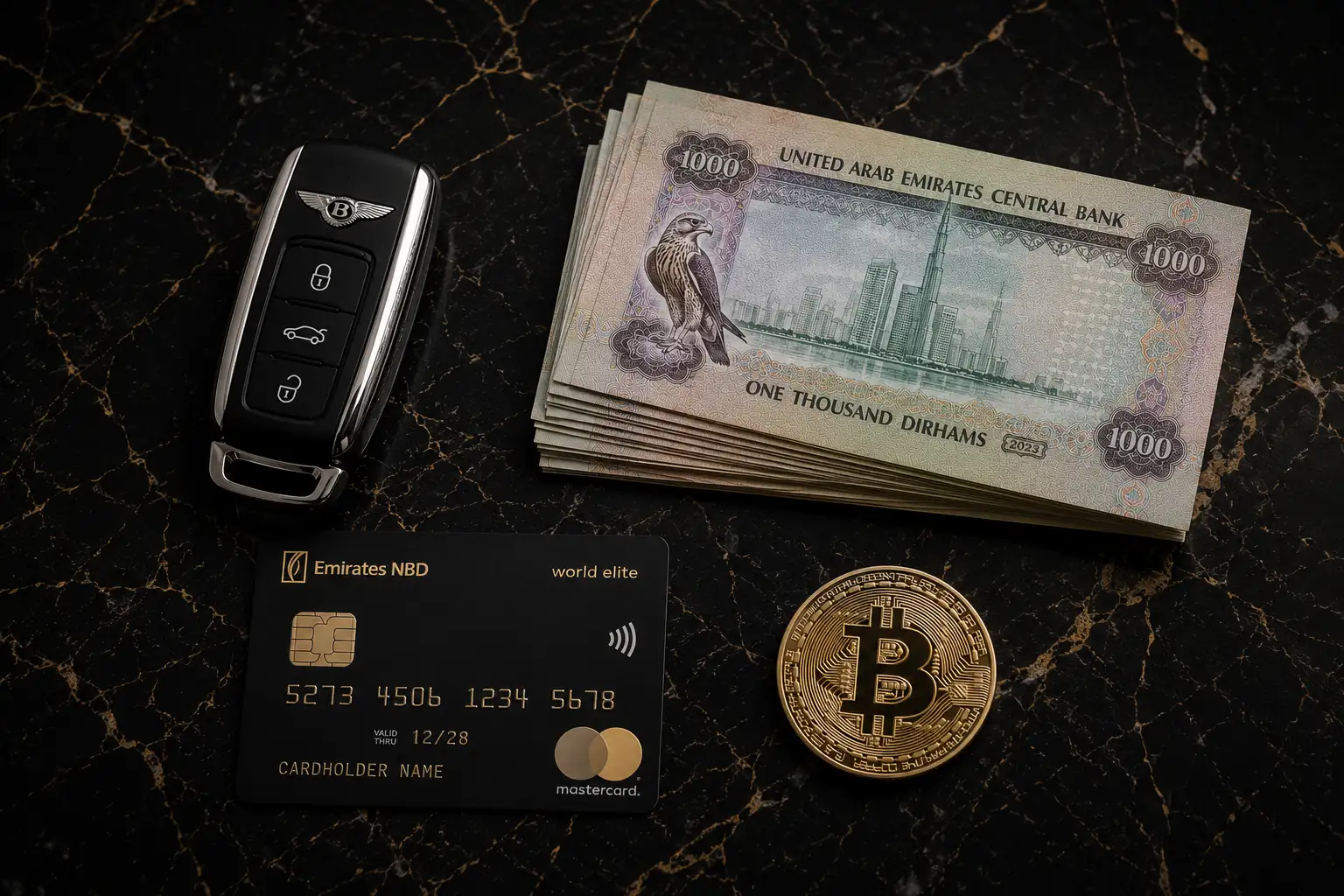
Choosing the right payment method for a luxury car in the UAE is a financial decision in its own right. Get it wrong, and you either tie up capital that should be working elsewhere, pay significantly more than the car’s purchase price over time, or expose yourself to settlement complications on a high-value asset.
The UAE market is one of the few in the world where all three methods – cash, bank finance, and cryptocurrency — are not only accepted but regularly used for transactions in the AED 300,000 to AED 2,000,000 range. Each has a specific buyer profile it suits, and each carries trade-offs that are worth understanding before you commit.
This guide breaks down all three clearly, so you can make the right call for your financial position.
Cash Payment: Full Ownership, Zero Obligations

Paying the full amount upfront is the most direct path to ownership available in the UAE luxury car market. There are no approval processes, no lender conditions, no monthly commitments, and no bank listed as a co-owner on the registration. The vehicle is yours outright from the moment the paperwork is signed.
Beyond simplicity, there is a practical negotiating advantage that comes with a cash offer. When a seller — whether a dealer or private party — knows the transaction can close the same day without financing conditions, that certainty carries weight. Buyers who arrive prepared, with funds in place and documentation ready, tend to move faster and, in many cases, close on better terms.
On the ownership side, there is no interest accrued over a loan tenure, no early settlement fee if you decide to sell before a term ends, and no procedural steps required to clear a lender’s interest before transferring the vehicle. That simplicity has real value in a market where clean, fast transactions are the standard expectation.
The Trade-Off: Liquidity Committed to a Single Asset
The direct cost of paying cash is capital immobilised. Committing AED 800,000 to a single vehicle purchase means that capital is no longer deployed elsewhere — whether in business operations, property, or investment positions. For buyers who are well-capitalised but active across multiple asset classes, a full cash payment is not always the most efficient decision, even when the funds are immediately available.
There is also a compliance dimension that every serious buyer should be prepared for. The UAE maintains strict anti-money laundering regulations, and large-value cash transactions require proper source-of-funds documentation. Reputable dealers follow this rigorously. Arriving with the necessary paperwork prepared is not optional — it is part of the transaction.
Best suited for: Buyers who want absolute simplicity, have the available liquidity, and prefer clean title with no ongoing financial obligation attached to the vehicle.
Bank Finance: A Smarter Structure for the Right Buyer
Financing a high-value vehicle in the UAE is not a compromise — for buyers with capital deployed elsewhere, it is frequently the more intelligent choice. The UAE’s banking infrastructure for luxury auto finance is mature, competitive, and accessible to both nationals and expatriates with the right profile.
Major institutions including Emirates NBD, ADCB, Mashreq, and First Abu Dhabi Bank offer auto loan products for premium and luxury vehicles. Financing is typically available up to AED 1,500,000 or beyond, depending on the applicant’s income and credit profile. Standard tenures run between 12 and 60 months. Broker-assisted finance is also available for buyers who prefer a streamlined process without managing the bank relationship directly.
Down payment requirements generally fall in the range of 20% for expatriates and 15% for UAE nationals, though this varies by institution and vehicle classification.
Why Financing Often Makes More Financial Sense Than Paying Outright
The core argument is capital efficiency. If your funds are generating returns in a business, a property position, or an equity portfolio, maintaining that exposure while financing a vehicle at a structured interest rate is often the stronger financial decision when the full picture is calculated.
Finance also provides predictability. Fixed monthly instalments on a AED 700,000 vehicle spread across 48 months are far easier to absorb within a broader financial plan than a single lump-sum outflow. For buyers managing business cash flow alongside personal expenditure, that structure is not just convenient — it is strategically sound.
For expatriate buyers building a financial profile in the UAE, a properly serviced auto loan also contributes positively to credit history. This matters considerably when a mortgage application or business financing facility becomes relevant later.
What to Factor In Before Signing a Finance Agreement
Interest is the direct cost of financing, and it compounds over the loan tenure. Buyers should calculate the total repayment figure — not just the monthly instalment — before committing. Depending on the rate agreed and the tenure selected, the total cost of a financed vehicle can exceed its purchase price by a meaningful margin.
Approval requires documentation: proof of income, UAE residency, Emirates ID, salary transfer confirmation, and in some cases, bank statements for the preceding three to six months. Buyers with non-standard income structures — business owners, commission-based earners, or those with income from multiple jurisdictions — may find the approval process more involved than anticipated.
Until the loan is fully settled, the bank holds an interest in the vehicle. If you decide to sell, export, or transfer the car before the term ends, the lender’s position must be cleared first, which adds procedural steps to the transaction.
Best suited for: Salaried professionals, business owners, and buyers who prefer to preserve liquidity and distribute the cost of a high-value asset across a structured, predictable repayment plan.
Cryptocurrency: A Regulated, Growing Payment Option in the UAE

Dubai’s position on digital assets has moved well beyond tolerance. The Virtual Assets Regulatory Authority (VARA) has established a formal regulatory framework that governs crypto transactions in the UAE — giving both buyers and sellers a clear, legally recognised basis for transacting in digital currency. For buyers, this matters: it means crypto payment in the UAE is not a grey area. It is a documented, compliant process with defined rules on both sides.
A growing number of luxury car dealers in Dubai now accept Bitcoin, Ethereum, and stablecoins, with USDT increasingly preferred due to its price stability. The standard process involves agreeing on an AED-equivalent price, calculating the corresponding crypto amount at a rate locked at the time of agreement, and completing the transfer within a defined settlement window. Stablecoin transactions remove exchange rate risk entirely, functioning with the same predictability as a bank transfer.
Why a Growing Segment of UAE Buyers Transact Entirely in Digital Assets
For buyers whose capital is held in digital assets, transacting directly avoids converting to fiat — a process that involves exchange fees, reporting requirements, and processing delays. If the funds are already in crypto, a direct purchase is the most efficient route available.
This is a practical reality for a defined segment of the UAE market. Buyers with backgrounds in technology, investment, and international business frequently hold a substantial portion of their net worth in digital assets. For them, paying in crypto is not experimental — it is simply where the money sits.
International buyers purchasing from Dubai and arranging export also find crypto advantageous. It bypasses currency conversion complications and the delays that accompany international wire transfers from jurisdictions with more restrictive banking environments, allowing transactions to close faster and with fewer intermediaries involved.
Volatility, Compliance, and What to Confirm Before Paying in Crypto
Price movement is the primary risk for non-stable cryptocurrencies. The value of a Bitcoin or Ethereum transaction can shift materially between the time of agreement and settlement. Reputable dealers manage this with a clearly locked AED-equivalent agreed at the point of sale and a tight settlement window — buyers should confirm both are in place before proceeding.
Compliance obligations apply here with the same rigour as cash. Under UAE regulations, crypto transactions require documentation of wallet ownership and source-of-asset declarations. Any dealer operating within VARA’s framework will ask for this. Buyers should approach a crypto transaction with the same preparation they would bring to any other high-value documented purchase.
Acceptance is also not universal across the market. Crypto remains dealer-dependent, and the settlement process involves more coordination than a standard wire transfer. Confirming acceptance and the process in advance saves time on both sides.
Best suited for: Buyers with substantial holdings in digital assets, international clients seeking a cleaner cross-border transaction, and those who prefer to avoid converting positions to fiat unnecessarily.
Choosing the Right Payment Method for Your Financial Position
The three methods suit different buyer profiles. The table below outlines the key variables:
| Cash | Bank Finance | Cryptocurrency | |
|---|---|---|---|
| Transaction Speed | Fast | Moderate | Fast |
| Negotiating Position | Strong | Moderate | Moderate |
| Ongoing Cost | None | Interest applies | None |
| Liquidity Impact | High | Low | Depends on holdings |
| Documentation Required | Moderate | Extensive | Moderate |
| Title from Day One | Yes | No (lender interest) | Yes |
| Availability | Universal | Bank-dependent | Dealer-dependent |
No single method is correct for every buyer. The right choice depends on where your capital is held, what obligations you want to carry, and how you prefer a transaction of this scale to close. All three are used regularly in the UAE luxury car market — by buyers who have considered their options carefully.
At Verano Motors, we work with buyers across all three payment methods. Every transaction is handled with full documentation and transparency, regardless of how payment is structured. If you have a specific vehicle in mind or want to understand what is possible for your situation, reach out directly — we will give you a straight answer.
Browse our current inventory at veranomotors.ae/inventory or contact us to discuss a specific vehicle.
Frequently Asked Questions
1. Which banks offer luxury car finance in the UAE?
Emirates NBD, ADCB, Mashreq, and First Abu Dhabi Bank all offer auto finance for luxury vehicles, with loan amounts reaching AED 1,500,000 or beyond depending on your income profile.
2. What is the typical down payment for a luxury car loan in the UAE?
Expatriates generally require a minimum of 20% down. UAE nationals typically qualify for 15%. This varies by institution and vehicle, so confirm directly with your lender.
3. Is cryptocurrency a legal payment method for cars in the UAE?
Yes. Dubai’s VARA has established a formal regulatory framework for crypto transactions. Paying in Bitcoin, Ethereum, or stablecoins is legally recognised, provided both parties meet the required compliance and documentation obligations.
4. Which cryptocurrency is most commonly used to buy cars in Dubai?
USDT is the preferred option as it tracks the US dollar, eliminating exchange rate risk between agreement and settlement. Bitcoin and Ethereum are also accepted, but a locked AED-equivalent rate at the time of agreement is essential.
5. Does financing a luxury car affect vehicle ownership in the UAE?
Yes. The bank holds an interest in the vehicle until the loan is fully repaid. Selling, exporting, or transferring the car before the term ends requires clearing the lender’s position first.