
 veranomotors

Dubai did not become a global automotive export hub by accident. It earned that position through a combination of pricing structure, vehicle quality, logistics infrastructure, and a climate that happens to be one of the most forgiving environments a car can spend its early years in. The result is a used car market that buyers from Africa, Europe, Asia, and beyond return to repeatedly, not because it is the closest option, but because it consistently delivers better value than the alternatives.
This is what drives that preference, and why it holds up under scrutiny.
Tax-Free Pricing That Creates a Structural Advantage Before Negotiation Even Begins
The UAE operates as a tax-free market for vehicle purchases. There is no VAT applied to car transactions, no export duty charged when a vehicle leaves the country, and free zones such as JAFZA (Jebel Ali Free Zone Authority) operate entirely outside UAE customs territory, meaning vehicles bought and held within them are never subject to local import duty before re-export.
For an international buyer, this creates a pricing advantage that is structural rather than situational. Comparable vehicles sourced from Europe carry VAT of between 19% and 22% depending on the country. Vehicles sourced from the US or Japan carry additional transaction costs: auction fees, export taxes, mandatory inspection requirements. The UAE has none of these at the point of sale.
In practical terms, international buyers consistently report savings of 20 to 40% against equivalent vehicles purchased in their home markets, before shipping costs are factored in. For high-value vehicles, that margin is significant enough to make UAE sourcing economically rational even after freight, insurance, and destination import duties are applied.
The Quality Argument: Low Mileage, Documented History, and a Climate That Works in the Buyer’s Favour

The UAE’s expatriate-heavy population has a particular effect on its used car market. Residents cycle through vehicles quickly, often selling within two to three years of purchase, and because the culture of authorised dealer servicing is strong, most vehicles entering the used market carry full, verifiable service histories. Many are still within manufacturer warranty at the point of sale.
The mileage profile of UAE-used vehicles is a consistent draw for international buyers. Urban distances are short, driving conditions are predominantly highway, and a large proportion of the expat population returns to their home country after two or three years, releasing near-new vehicles into the market at prices that reflect the UAE’s high turnover rather than the vehicle’s actual condition.
The climate argument is one that is often underestimated. Vehicles in the UAE are never exposed to road salt, winter corrosion, or the freeze-thaw cycles that cause structural deterioration in European and North American markets. A five-year-old vehicle from the UAE will typically show considerably less undercarriage wear than a three-year-old equivalent from Germany or the UK. For buyers in Africa, South Asia, and the Middle East, markets where the same hot, dry conditions prevail, a GCC-spec vehicle is also calibrated for the environment it will be used in, with cooling systems, engine tolerances, and air conditioning specifications matched to extreme heat rather than temperate European conditions.
GCC Specification: Built for Conditions That Most of the World Actually Has
GCC-specification vehicles are not simply standard global models with a different badge. They are factory-configured for sustained high-temperature operation: enhanced cooling systems, reinforced AC capacity, and in many cases, suspension tuning suited to the road surfaces and load conditions of the region.
For buyers in Africa, South Asia, and the broader Middle East, this matters practically. A European-spec vehicle transplanted into a West African or South Asian operating environment is working outside its design parameters from day one. A GCC-spec vehicle sourced from the UAE is already calibrated for heat, dust, and the kind of sustained urban and highway use that characterises driving in those markets.
This is one of the reasons GCC-spec Toyota Land Cruisers, Nissan Patrols, and Lexus SUVs command consistent demand across export markets: the specification aligns with the conditions, which reduces long-term maintenance costs and improves reliability over time.
Jebel Ali: A Logistics Infrastructure That No Other Market Matches
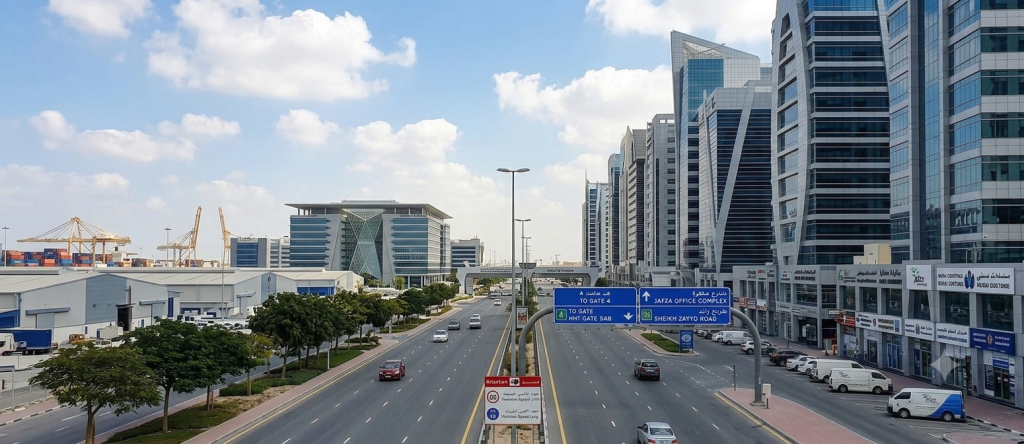
Geography compounds the UAE’s pricing and quality advantages with a logistical one. Jebel Ali Port, one of the largest and most advanced container ports in the world, connects directly to over 150 ports globally. Shipping routes from Dubai reach West Africa, East Africa, South Asia, Central Asia, Eastern Europe, and the broader Middle East with freight timelines and costs that no comparable automotive sourcing market can match from a single point.
The JAFZA free zone sits adjacent to Jebel Ali Port, meaning vehicles can be purchased, processed, and loaded for export with minimal transit between stages. Digital clearance systems have further reduced documentation processing times. For buyers who operate at volume, this efficiency directly affects the economics of each transaction.
The combination of Jebel Ali’s reach and JAFZA’s duty-free structure is a significant reason why Dubai has become the natural aggregation point for vehicles arriving from the US, Japan, Korea, and Europe before onward distribution. It is not just a source market, it is a redistribution hub.
Inventory Depth and Brand Diversity That No Single Market Replicates
The UAE market carries an inventory range that reflects both its affluent local population and its role as a regional distribution hub. Buyers can source Japanese reliability in the form of Toyota, Nissan, and Lexus alongside German luxury from Mercedes-Benz, BMW, and Porsche, American performance and utility vehicles from Chevrolet, RAM, and Cadillac, and Korean value from Hyundai and Kia, all from a single market, with comparable transaction processes and documentation standards.
For export dealers who serve diverse end markets, this breadth is operationally valuable. A single sourcing trip or relationship with a UAE dealer can yield vehicles for multiple buyer profiles across different destination countries, something that is considerably harder to replicate when working across Japan, the US, and Europe simultaneously.
At Verano Motors, a significant proportion of enquiries come from international buyers and export dealers who source low-mileage European-brand vehicles, Mercedes-Benz, BMW, Porsche, for resale into markets where those vehicles are substantially more expensive to acquire locally. The combination of specification quality, documented history, and competitive UAE pricing makes the economics work even after export costs are accounted for.
Transparent Documentation and a Regulated Framework
One concern that legitimate export buyers carry when sourcing from any used car market is documentation integrity. The UAE’s Roads and Transport Authority (RTA) provides official mileage verification, and regulated dealerships operate within a framework that requires proper vehicle history disclosure. Export certificates, deregistration documentation, and customs clearance are standardised processes with established timelines.
This is not the case in every source market. The UAE’s regulatory framework, combined with its reputation for contract enforceability and business transparency, gives international buyers a level of confidence that is not always available when sourcing from auction-heavy markets or less regulated trading environments.
For buyers making high-value transactions across borders, where the cost of receiving a misrepresented vehicle is both financial and reputational, this matters considerably.
Currency Stability and Ease of International Payment
The UAE dirham has been pegged to the US dollar since 1997, at a fixed rate that has not moved in nearly three decades. For international buyers, this removes a variable that complicates sourcing from other markets: there is no need to hedge against currency swings between the time a deal is agreed and the time payment clears.
Banking infrastructure reinforces this. Dubai’s dealers and free zone entities are accustomed to handling international wire transfers, letters of credit, and escrow arrangements for buyers who have never set foot in the country. Combined with English as a standard business language across contracts and correspondence, this makes remote purchasing, common among export dealers who buy in volume without visiting personally, considerably more straightforward than in markets where currency controls, language barriers, or informal payment practices add friction to every transaction.
A Resale Market That Rewards Repeat Buyers
Export dealers who return to the UAE market year after year tend to build relationships with specific dealers, inspection agents, and freight forwarders, and that repetition compounds into an advantage that a one-time buyer does not get. Established relationships mean earlier access to incoming stock, more accurate condition reporting before a vehicle is even listed, and more flexibility on payment terms.
This repeat-buyer dynamic also feeds back into the market’s overall reliability. Dealers who depend on export volume have a direct incentive to maintain accurate documentation and disclose vehicle history honestly, since reputational damage among a network of returning international buyers is costly in a way that a single disputed sale to a local buyer is not. For new entrants to export sourcing, this means the market has already been shaped, over years, by buyers with the most to lose from being misled.
Frequently Asked Questions
1. Why do international buyers prefer UAE cars over vehicles sourced from Japan or Europe?
The UAE offers tax-free pricing, low mileage, documented service histories, and GCC specification simultaneously. Japan carries auction fees and export taxes. Europe carries VAT of 19 – 22%. The UAE offers both without either.
2. What does GCC specification mean and why does it matter for export buyers?
GCC-spec vehicles are factory-configured for high-temperature operation – stronger cooling systems, higher AC capacity, and engine tolerances built for sustained heat. For buyers in Africa, South Asia, and the Middle East, this means the vehicle is already suited to the conditions it will operate in.
3. How much can an export buyer typically save by sourcing from the UAE?
International buyers consistently report savings of 20 to 40% against equivalent vehicles in their home markets, a margin that typically remains advantageous after freight, insurance, and destination import duties are applied.
4. Is there export duty charged when taking a car out of the UAE?
No. The UAE charges zero export duty on vehicles leaving the country. Vehicles purchased within JAFZA are also never subject to local import duty, making re-export entirely cost-free at the UAE end.
5. Why is Jebel Ali Port important for export buyers?
Jebel Ali connects directly to over 150 ports worldwide, offering faster and more cost-efficient freight to Africa, Asia, and Europe than most competing source markets. Its adjacency to JAFZA simplifies the process from purchase to loading.